We went on a field trip to Sycamore Shoals
Showing posts with label Field Trips. Show all posts
Friday, October 16, 2009
Sycamore Shoals State Historic Area
Our Co-op went to Sycamore Shoals State Historic Area. This was one of the earliest settlements outside of the original 13 colonies. We participated in a program describing the Fort, period dress, etc. Then the children played a game from the time period and toured the fort. They also got to see a musket fired. Finally, the kids made corn husk dolls.

Tuesday, October 6, 2009
Fender's Farm
Monday, August 24, 2009
Natural Tunnel
Friday, August 21, 2009
Morristown Safari Ranch
Saturday, August 8, 2009
Blueberry Picking/ Davy Crockett Birthplace State Park
Friday, May 15, 2009
Natural Tunnel Park
Monday, April 13, 2009
Bays Mountain Planetarium
By Keegan
Our co-op visited Bays Mountain Planetarium. The planetarium had just been redone so it looked beautiful. It had a better stargazer and better 3-D abilities. We watched a program called Connections. We were on Pegasus' back and we went through the galaxies. One part we went through our own Milky Way galaxy and saw lots of planets. The program pointed out some of the constellations like Orion's Belt, The Drinking Gourd, Pegasus, and The Big Bear.
By Keegan
Our co-op visited Bays Mountain Planetarium. The planetarium had just been redone so it looked beautiful. It had a better stargazer and better 3-D abilities. We watched a program called Connections. We were on Pegasus' back and we went through the galaxies. One part we went through our own Milky Way galaxy and saw lots of planets. The program pointed out some of the constellations like Orion's Belt, The Drinking Gourd, Pegasus, and The Big Bear.
Friday, March 20, 2009
Natural History Museum- Gray Fossil Site
Gray Fossil Site
By Keegan, McKenna and Braden
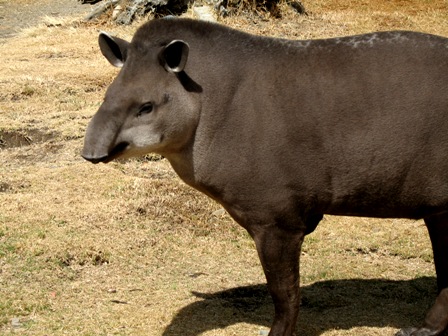
We went to the Gray Fossil Site with our co-op. This site was found when the road workers were digging to widen a road. They found bones from the Micene period. They stopped building the road and scientists from ETSU have been digging for bones ever since. Some of the fossils they have found are: alligators, red pandas, lizards, snakes, short faced bears, camels, shovel tusked elephants, saber toothed cat, rhinos, and tapirs (see picture). This site has the most tapir fossils (over 50) in the world.

First we watched a movie about the digging. Then we toured the museum and saw many of the bones and animals that had been found. Then we went outside and saw the actual dig sites. There were men there actually digging for the rest of a shovel tusked elephant. Then we went to the rhino pit and we saw a bunch of limestone rock. Then we went to a tent and we started to look for bones ourselves! One of the boys in our co-op found some type of bone.
By Keegan, McKenna and Braden
We went to the Gray Fossil Site with our co-op. This site was found when the road workers were digging to widen a road. They found bones from the Micene period. They stopped building the road and scientists from ETSU have been digging for bones ever since. Some of the fossils they have found are: alligators, red pandas, lizards, snakes, short faced bears, camels, shovel tusked elephants, saber toothed cat, rhinos, and tapirs (see picture). This site has the most tapir fossils (over 50) in the world.

First we watched a movie about the digging. Then we toured the museum and saw many of the bones and animals that had been found. Then we went outside and saw the actual dig sites. There were men there actually digging for the rest of a shovel tusked elephant. Then we went to the rhino pit and we saw a bunch of limestone rock. Then we went to a tent and we started to look for bones ourselves! One of the boys in our co-op found some type of bone.
Friday, March 6, 2009
Big Stone Gap Museums
Harry W. Meador Jr. Coal Museum
By Keegan, McKenna, and Braden
The first Museum we visited was the Harry W. Meador Jr. Coal Museum. There was a man who had been coal mining for 30 years that showed us around. On the fireplace there were many fake miners made out of clay. There was a couch that had cushions and pillows with designs of miners on it. He showed us some mining tools: mining helmets, flashlight that are worn on the head, chisels, and a hammer to hit on the roof to see if it was solid. There was also a tool used to hold the roof up to make sure it wouldn't fall on them. The lunch bucket that he is holding below was a miner's lunchbox. It had various sections that held different items to eat.

There were lots of pictures of local miners in the museum. One picture had two skeletons carrying a coffin. It said "Who is Going to Die in the Mines Next?"

Outside of the museum were these huge machines used to take coal out of the mine. The rollers on the front were used to grind up dirt and make a passageway.

SouthWest Virginia Museum
By McKenna
The second museum we visited was the Southwest Virginia Museum.


This museum showed what life was like a long time ago in the Appalachian areas. We saw a lot of tools, washing boards, big tubs used for washing clothes, and a coffee machine. Women would wear bathing suits like the one below to go swimming or wading! If you went down in the basement and out the door, you would see a hollow moat. The children would clog the drain and fill it up with water and swim in it.


By Keegan, McKenna, and Braden
The first Museum we visited was the Harry W. Meador Jr. Coal Museum. There was a man who had been coal mining for 30 years that showed us around. On the fireplace there were many fake miners made out of clay. There was a couch that had cushions and pillows with designs of miners on it. He showed us some mining tools: mining helmets, flashlight that are worn on the head, chisels, and a hammer to hit on the roof to see if it was solid. There was also a tool used to hold the roof up to make sure it wouldn't fall on them. The lunch bucket that he is holding below was a miner's lunchbox. It had various sections that held different items to eat.
There were lots of pictures of local miners in the museum. One picture had two skeletons carrying a coffin. It said "Who is Going to Die in the Mines Next?"
Outside of the museum were these huge machines used to take coal out of the mine. The rollers on the front were used to grind up dirt and make a passageway.
SouthWest Virginia Museum
By McKenna
The second museum we visited was the Southwest Virginia Museum.


This museum showed what life was like a long time ago in the Appalachian areas. We saw a lot of tools, washing boards, big tubs used for washing clothes, and a coffee machine. Women would wear bathing suits like the one below to go swimming or wading! If you went down in the basement and out the door, you would see a hollow moat. The children would clog the drain and fill it up with water and swim in it.
Subscribe to:
Posts (Atom)